
The assumption that the aod 9604 peptide is merely a scaled-down version of human growth hormone is a technical oversight that frequently undermines laboratory precision. While both share a structural lineage, the specific C-terminal fragment modification in AOD-9604 creates a distinct metabolic profile that requires its own set of rigorous validation protocols. You’ve likely encountered the frustration of inconsistent purity levels and the absence of verifiable Certificates of Analysis when sourcing compounds for your research. It’s difficult to maintain experimental stability when the molecular integrity of your primary material is in question.
This article serves as a definitive technical resource for understanding the molecular properties and research mechanisms of the aod 9604 peptide. We’ll clarify the structural differences between this 176-191 fragment and full-length hGH, ensuring your laboratory protocols are based on accurate chemical data. By examining the necessity of high-purity standards and transparent COA documentation, this guide assists you in establishing a reliable framework for your scientific workflows. We’ll also review the specific laboratory specifications required to maintain the stability of 10mg vials throughout the duration of your study.
Key Takeaways
- Differentiate the C-terminal fragment from the HGH polypeptide chain to refine your laboratory research objectives.
- Access the exact molecular specifications of the aod 9604 peptide required for precise mass calculations and experimental consistency.
- Analyze the beta-3 adrenergic receptor pathways that facilitate lipolysis within specialized adipose tissue models.
- Identify critical verification markers in COA documentation, including HPLC purity assessments and Mass Spectrometry identity checks.
- Implement stable storage protocols using deep-freeze temperatures and moisture control to ensure the longevity of lyophilized compounds.
What is AOD-9604? The C-Terminal Fragment of Growth Hormone
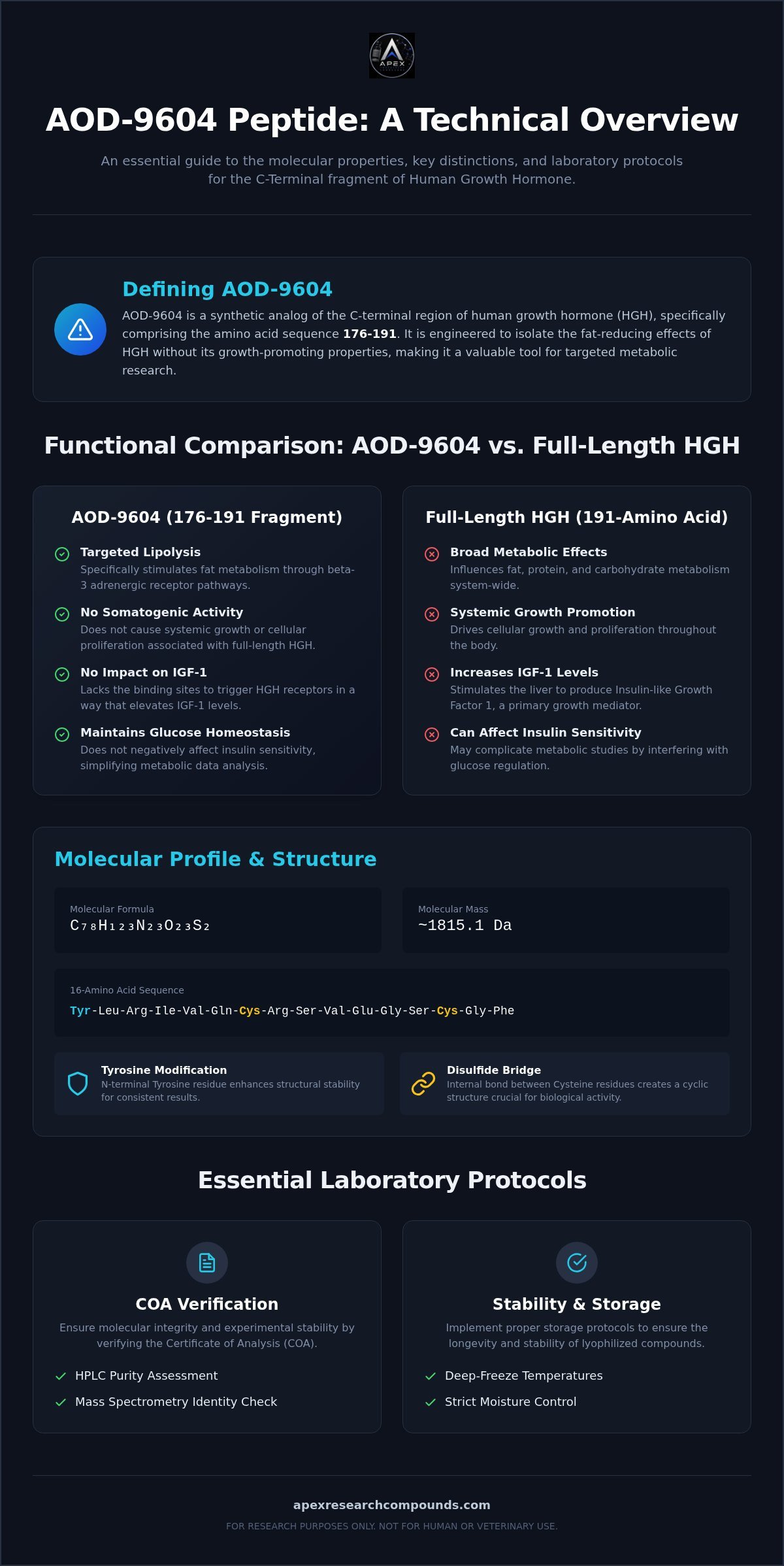
AOD-9604 is a synthetic analog of the C-terminal region of human growth hormone (HGH). It specifically encompasses the amino acid sequence from 176 to 191 of the HGH polypeptide chain. Researchers isolated this fragment to study its influence on lipid metabolism without the systemic growth effects associated with the full 191-amino acid HGH molecule. Within a laboratory setting, the aod 9604 peptide is strictly categorized as a research chemical. It’s not intended for clinical, human, or veterinary applications. This distinction is vital for maintaining procedural integrity in professional research environments.
The History of the 176-191 Fragment
The development of this fragment originated at Monash University in Australia. Researchers sought to identify the specific portion of HGH responsible for fat metabolism. Early studies focused on the raw HGH fragment 176-191; however, this sequence lacked the structural stability required for consistent laboratory results. The transition to AOD-9604 involved key modifications, specifically the addition of a tyrosine residue at the N-terminal end. This modification enhances the stability of the peptide sequence, allowing for more precise data collection during metabolic research. These structural adjustments ensure that the compound remains functional throughout complex laboratory workflows.
AOD-9604 vs. Full-Length HGH
The primary distinction between the aod 9604 peptide and native HGH lies in the absence of somatogenic activity. HGH is known to increase insulin-like growth factor 1 (IGF-1) levels, which drives cellular growth and proliferation. Structural analysis reveals that the 176-191 fragment doesn’t possess the binding sites necessary to trigger the HGH receptor in a way that elevates IGF-1. This isolation of function is critical for research models focusing purely on lipolytic mechanisms. It allows for a narrower focus on adipose tissue response without the variable of systemic growth stimulation.
Native HGH often affects insulin sensitivity, which can complicate metabolic data. AOD-9604 doesn’t demonstrate these inhibitory effects in controlled laboratory environments. By removing the residues responsible for growth-promoting activity, the peptide allows researchers to observe fat metabolism pathways without interfering with glucose homeostasis. Standardized research protocols typically utilize 10mg vials to ensure consistency across multiple test batches and maintain precise concentration levels. This focus on functional specificity makes it a valuable tool for targeted metabolic studies.
Molecular Characteristics and Synthetic Specifications
The molecular profile of the aod 9604 peptide is defined by its precise 16-amino acid sequence. This synthetic polypeptide is characterized by the following chemical specifications:
- Molecular Formula: C78H123N23O23S2
- Molecular Mass: Approximately 1815.1 Da
- Sequence: Tyr-Leu-Arg-Ile-Val-Gln-Cys-Arg-Ser-Val-Glu-Gly-Ser-Cys-Gly-Phe
- Physical State: Sterile-filtered, white lyophilized powder
This freeze-drying process is essential for maintaining the structural integrity of the peptide bonds during transport and storage. Unlike raw fragments, this refined state prevents the premature degradation of the amino acid chain when exposed to environmental fluctuations. The lyophilization also ensures that the final product is free from moisture, which otherwise facilitates hydrolytic cleavage of the peptide chain.
Chemical Structure Analysis
Stability in synthetic peptides is often contingent on specific molecular modifications. In AOD-9604, the addition of a Tyrosine (Tyr) residue at the 176 position is a critical divergence from the native HGH 176-191 fragment. This modification facilitates better structural stability during laboratory synthesis. While it’s common to encounter raw HGH fragments, researchers don’t typically use them for high-precision metabolic studies due to their inherent instability. The formation of an internal disulfide bridge between the two Cysteine (Cys) residues at positions 7 and 14 is the primary driver of biological activity for the aod 9604 peptide. This bridge creates a cyclic structure that mimics the active domain of human growth hormone. Research published on the Safety and Metabolism of AOD9604 highlights how these structural nuances influence its metabolic interactions in research models. Without the disulfide bond, the peptide’s ability to stimulate lipolytic pathways in laboratory models is significantly diminished.
Quantitative Standards for 10mg Vials
Standardizing research protocols requires a consistent mass of the active compound. Utilizing 10mg vials allows for precise calculation across multiple experimental cohorts without the need for frequent micro-measurements. The lyophilization process used for these units removes all moisture, resulting in a stable powder that contains no unnecessary additives or interfering buffers. Researchers must apply accurate reconstitution math to ensure experimental validity. For instance, adding 2mL of a diluent to a 10mg vial yields a concentration of 5mg/mL. This concentration is often the baseline for in vitro studies involving adipose tissue. Maintaining this level of precision is paramount for reproducible data. For laboratories requiring documented verification of these specifications, sourcing high-purity AOD-9604 10mg vials with accompanying COAs is the professional standard. High-resolution mass spectrometry is typically employed to verify that the final product matches the 1815.1 Da specification exactly, ensuring no truncated sequences are present.
Mechanism of Action in Laboratory Research Models
The physiological influence of the aod 9604 peptide is primarily mediated through its interaction with beta-3 adrenergic receptors. These receptors, predominantly located in white adipose tissue, serve as the gateway for lipid mobilization. When the peptide binds to these specific sites, it triggers a cascade that activates hormone-sensitive lipase (HSL). This enzyme is responsible for the hydrolysis of stored triglycerides into free fatty acids and glycerol. The secondary mechanism involves the inhibition of lipogenesis, which is the biological process of converting non-fat precursors into new adipose tissue. By downregulating the enzymes involved in fat synthesis, the peptide effectively restricts the formation of new lipid stores. Unlike full-length growth hormone, this fragment operates with high specificity, avoiding the growth hormone receptor (GHR) entirely. This non-somatogenic profile is why the compound doesn’t induce cellular proliferation or increase IGF-1 levels in research subjects.
Lipolytic Activity and Adipose Tissue
In vitro studies utilize the measurement of glycerol release as a quantitative marker for lipolytic efficacy. When adipose tissue models are exposed to AOD-9604, researchers observe a significant increase in extracellular glycerol, indicating the breakdown of stored fats. This process occurs without the typical metabolic interference associated with HGH. Specifically, the peptide doesn’t negatively impact systemic glucose levels or insulin sensitivity. This characteristic allows for the study of fat metabolism in isolation, providing a cleaner data set for metabolic research. The absence of insulin resistance in these models is particularly significant for longitudinal studies involving metabolic syndrome or other insulin-sensitive research subjects.
Research Applications in Regenerative Medicine
Beyond lipid metabolism, the aod 9604 peptide is gaining attention in regenerative medicine models, particularly concerning cartilage repair. Preliminary studies investigate its potential in osteoarthritis models, where it may support the synthesis of proteoglycans and collagen. Researchers often explore the synergistic effects of combining this fragment with other compounds. For instance, studying AOD-9604 alongside CJC-1295 provides a more comprehensive view of how different peptide pathways interact to influence body composition and tissue repair in obesity-prone laboratory models. These multi-peptide protocols are essential for understanding complex metabolic interactions in a controlled environment. Current research protocols often focus on the administration of 10mg vials to maintain standardized concentrations across these varied applications.
Interpreting COA Documentation for AOD-9604
Professional research requires verifiable data to ensure experimental reproducibility. A Certificate of Analysis (COA) is the primary document used to confirm the chemical integrity of the aod 9604 peptide. It provides empirical evidence that the compound matches the theoretical specifications outlined in the molecular analysis. Without this documentation, researchers risk introducing unknown variables into their metabolic models, which can lead to skewed data and invalid conclusions. Every batch must undergo rigorous testing to verify both identity and purity before it’s cleared for laboratory use.
Reading an HPLC Chromatogram
High-Performance Liquid Chromatography (HPLC) is the standard method for determining the chemical purity of a peptide sample. The resulting report displays a chromatogram where the x-axis represents retention time and the y-axis represents absorbance. Purity is calculated by measuring the “area under the curve” for the main peak relative to the total area of all detected peaks. For high-grade research, a purity threshold of 98% or higher is the expected norm.
- Main Peak: This should be the dominant feature of the report, representing the target peptide.
- Secondary Peaks: These indicate the presence of potential contaminants, residual solvents, or degradation products.
- Baseline Stability: A flat baseline indicates a clean sample free from significant amorphous impurities or electronic noise.
Mass Spectrometry Analysis
While HPLC confirms purity, Mass Spectrometry (MS) verifies the specific identity of the aod 9604 peptide. The MS report provides a mass-to-charge (m/z) ratio that acts as a molecular fingerprint. For this specific fragment, the primary peak must align with the theoretical molecular mass of 1815.1 Da. This verification ensures that the amino acid sequence hasn’t been truncated or improperly synthesized during the manufacturing process. Traceability is critical in professional procurement; every report must be linked to a specific batch number to maintain a clear chain of custody from the laboratory to your facility.
Reliability in a structured research environment is built on this level of transparency. Every 10mg vial should be accompanied by batch-specific documentation to prevent the use of substandard materials. This rigorous verification protects the validity of your results and ensures that your study of lipolytic mechanisms is based on a stable, high-purity compound. To maintain these standards in your workflow, you can buy AOD-9604 10mg with verifiable COAs to ensure total procedural integrity.
Stability and Storage Protocols for AOD-9604
Maintaining the molecular integrity of the aod 9604 peptide requires strict adherence to thermal and environmental controls. In its lyophilized state, the compound is stable at room temperature for brief intervals, but long-term preservation necessitates storage at -20°C or -80°C. These sub-zero temperatures arrest molecular motion and prevent the spontaneous cleavage of peptide bonds. Exposure to light and moisture represents a significant risk to the compound’s stability. Utilizing desiccated environments and amber-vial storage is necessary to mitigate the risks of photodegradation and hydrolysis, which can compromise the peptide’s primary sequence.
Once reconstituted, the stability window for the solution narrows significantly. The liquid peptide must be maintained at a constant 4°C within a laboratory refrigerator. At this temperature, the compound remains viable for active research phases, typically lasting between 7 and 14 days. Bacteriostatic water is the preferred diluent for multi-use laboratory vials because it inhibits microbial growth, though sterile saline is an acceptable alternative for short-term protocols. Researchers must monitor the solution’s clarity throughout the active phase to ensure no degradation has occurred.
Optimal Reconstitution Technique
Reconstitution is a critical phase where mechanical stress can damage the peptide’s secondary structure. Researchers should introduce the diluent slowly, allowing the liquid to flow down the interior wall of the glass vial rather than directly onto the lyophilized powder. It’s essential to use gentle swirling rather than vigorous agitation. Shaking the vial can cause the aod 9604 peptide to denature or aggregate, rendering the sample useless for precise metabolic study. Precision in concentration is vital for experimental dosing. For instance, adding 2mL of diluent to a 10mg vial yields a 5mg/mL concentration. For high-precision workflows, utilizing a peptide reconstitution calculator ensures mathematical accuracy and minimizes the risk of human error.
Aliquot Management for Research Continuity
To ensure research continuity and data reliability, implementing an aliquot management system is standard laboratory practice. Dividing the reconstituted solution into smaller, single-use volumes prevents the detrimental effects of repeated freeze-thaw cycles. These cycles can cause significant structural degradation through ice crystal formation. Each aliquot should be clearly labeled with the batch number, concentration, and date of reconstitution to maintain inventory transparency. Researchers must vigilantly monitor the solution for physical signs of degradation. The appearance of cloudiness, precipitation, or any loss of clarity indicates that the peptide has begun to aggregate. Such samples must be discarded to protect the validity of the research data.
Advancing Metabolic Research with Verified Peptide Standards
Precise metabolic study depends on the chemical integrity of your primary materials. The aod 9604 peptide offers a targeted mechanism for investigating lipolytic pathways without the confounding variables of growth hormone receptor activation. By prioritizing the structural isolation of the 176-191 fragment and adhering to documented storage protocols, you maintain the stability necessary for reproducible data. Verification through batch-specific documentation remains the professional standard for confirming that your compound meets the required analytical specifications.
Apex Research Compound supports these requirements by providing documented 98%+ purity via HPLC and Mass Spectrometry. Every order includes a batch-specific COA and is managed through global discrete shipping for laboratory professionals. This focus on transparency ensures that your research workflows are supported by reliable, high-purity compounds. Establishing a consistent supply chain with verified data allows you to maintain the technical rigor of your metabolic models.
Secure High-Purity AOD-9604 10mg for Your Research and ensure the integrity of your laboratory protocols.
Frequently Asked Questions
What is the specific amino acid sequence of AOD-9604?
The specific sequence of the aod 9604 peptide is Tyr-Leu-Arg-Ile-Val-Gln-Cys-Arg-Ser-Val-Glu-Gly-Ser-Cys-Gly-Phe. This 16-amino acid chain includes a Tyrosine residue at the N-terminal position, which distinguishes it from the raw HGH 176-191 fragment. This modification is essential for enhancing the structural stability of the peptide during laboratory synthesis and subsequent experimental phases. Precise sequence verification is a prerequisite for maintaining the accuracy of metabolic research data.
Is AOD-9604 the same as HGH Fragment 176-191?
AOD-9604 isn’t identical to the native HGH Fragment 176-191. While it’s derived from that region, it’s a stabilized analog featuring an additional Tyrosine residue at the 176 position. This structural modification was engineered to improve the compound’s stability and metabolic half-life in research environments. Researchers shouldn’t use these terms interchangeably, as the chemical properties and stability profiles of the two compounds differ significantly in a laboratory setting.
How should AOD-9604 be stored for long-term research?
For long-term preservation, the lyophilized powder must be stored at -20°C or -80°C in a desiccated environment. These sub-zero temperatures effectively halt molecular motion and preserve the integrity of the peptide bonds. Vials should also be shielded from light exposure, typically through the use of amber glass or opaque containers. Proper storage ensures that the compound remains stable for the duration of the study, preventing the formation of degradation products.
What purity level is required for reliable AOD-9604 research?
Professional research requires a purity level of 98% or higher to ensure the validity of experimental results. Substandard purity can introduce unknown variables into your metabolic models, leading to inconsistent or uninterpretable data. Verification of these levels is performed using High-Performance Liquid Chromatography (HPLC) and Mass Spectrometry (MS). Sourcing the aod 9604 peptide with documented high-purity standards is critical for maintaining the technical rigor expected in a professional laboratory environment.
Can AOD-9604 be reconstituted with sterile water?
AOD-9604 can be reconstituted with sterile water, but bacteriostatic water is the standard choice for multi-use vials. Bacteriostatic water contains 0.9% benzyl alcohol, which inhibits the growth of bacteria that could contaminate the solution over time. If the researcher intends to use the entire vial in a single session, sterile saline or water is sufficient. However, for active research phases lasting several days, bacteriostatic water provides a necessary layer of procedural security.
Does AOD-9604 affect insulin levels in research models?
Current laboratory models indicate that AOD-9604 doesn’t adversely affect systemic insulin levels or glucose sensitivity. This is a primary distinction between this fragment and full-length human growth hormone. By isolating the C-terminal region, researchers can observe lipolytic mechanisms without the risk of inducing insulin resistance or other somatogenic effects. This characteristic makes it a valuable tool for studying fat metabolism in models where maintaining glucose homeostasis is a procedural requirement.
What is the molecular weight of high-purity AOD-9604?
The theoretical molecular weight of high-purity AOD-9604 is approximately 1815.1 Da (Daltons). This mass is calculated based on the specific 16-amino acid sequence and its chemical modifications. Verification of this molecular weight through mass spectrometry is essential for confirming that the peptide hasn’t been truncated or improperly synthesized. Any significant deviation from this weight in a COA report indicates a lack of identity verification, which could compromise the integrity of the research.
Why is a COA necessary for AOD-9604 procurement?
A Certificate of Analysis (COA) is mandatory for procurement because it provides empirical proof of a compound’s identity and purity. It offers transparency by detailing the results of HPLC and MS testing for a specific batch. Without a COA, there’s no objective way to verify that the 10mg vial contains the correct peptide or meets the necessary purity thresholds. This documentation ensures traceability and accountability, which are fundamental requirements for professional laboratory workflows.